

Disclaimer: This article is for general information only and is not a substitute for medical advice. If you have severe, ongoing or unusual neck pain, please see a doctor or a qualified physiotherapist before starting any exercise.
Quick Answer: What Are the Best Neck Pain Exercises for Desk Workers?
The best neck pain exercises for desk workers are gentle movements that undo the "head forward, shoulders rounded" posture of screen work. Chin tucks, neck side bends, levator scapulae stretches, neck rotations, shoulder rolls, shoulder blade squeezes, doorway chest stretches and upper back extensions over a chair cover the main areas.
How often: Little and often, a few times a day
How long: 5 to 10 minutes per session
How it should feel: Mild stretch is fine, sharp pain is not
Best results: Combine the exercises with a better desk setup and regular breaks
When to stop: If you get numbness, tingling, arm weakness or pain that spreads, stop and see a doctor
If your knees also ache after long hours at a desk, try these simple knee pain exercises.
Why Do Desk Workers Get Neck Pain?
Desk workers get neck pain mainly because they hold the same position for hours, often with the head pushed forward towards a screen. This puts extra load on the neck and upper back muscles, which is exactly what targeted neck pain exercises aim to relieve.
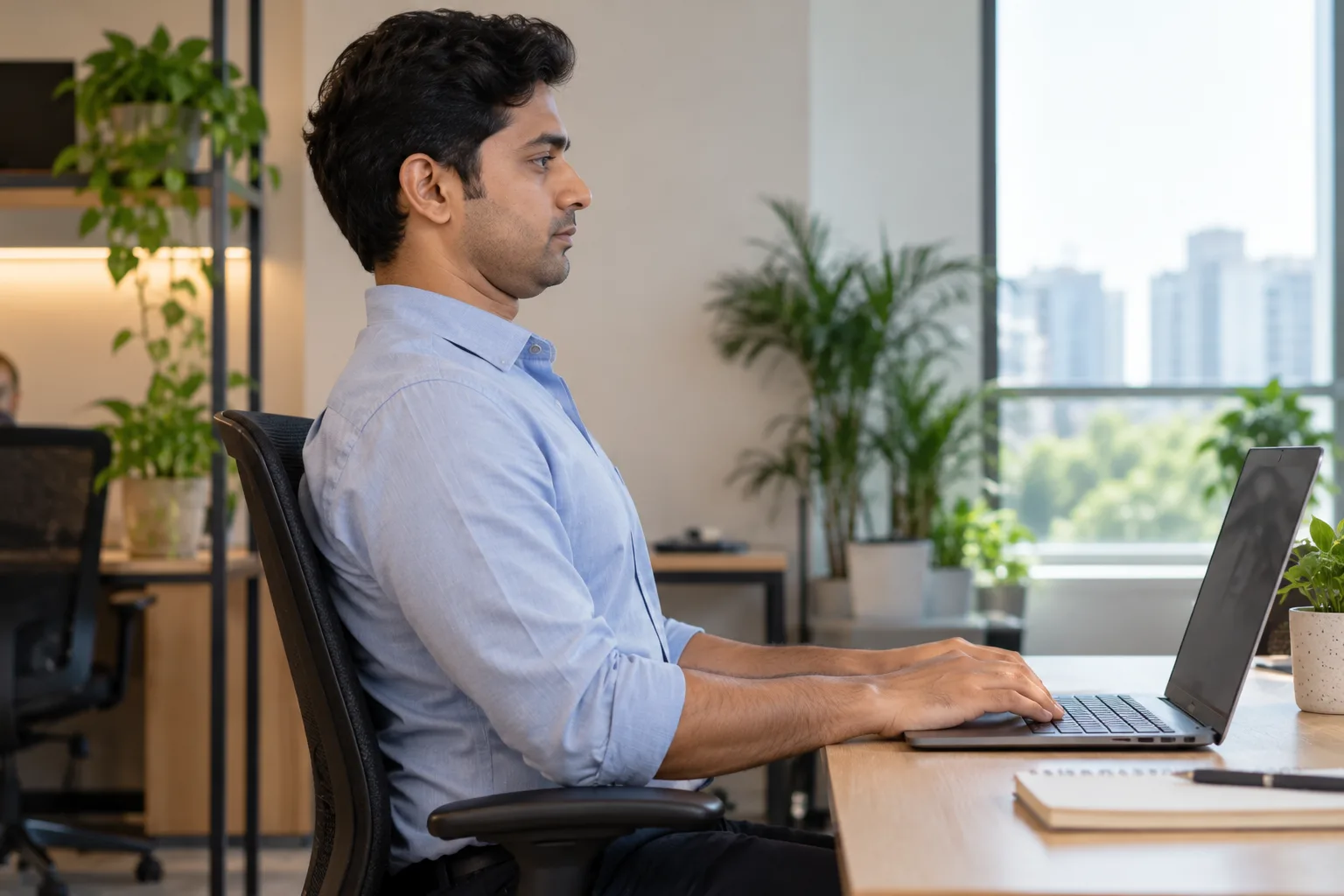
Forward Head Posture and "Tech Neck"
When your head drifts forward, your neck has to work much harder to hold it up. A widely cited 2014 study by spine surgeon Kenneth Hansraj, published in Surgical Technology International, used a computer model to estimate the load on the neck. It found the effective weight rose from about 5 kg (10 to 12 lb) with the head upright to about 12 kg at 15 degrees forward and about 27 kg at 60 degrees.
The study used a model, not live measurements, so treat the numbers as an illustration.
Screen Height
A laptop on a desk sits too low for most people, so you look down for hours. Mayo Clinic advises keeping the top of the screen at or slightly below eye level, about an arm's length away.
Static Posture
Even a "perfect" posture gets tiring if you hold it all day. The NHS-run Dynamic Health physiotherapy service notes that changing position regularly can prevent pain from long, still postures.
Do Neck Pain Exercises Actually Help?
Yes. Research shows neck pain exercises help office workers with neck pain, and strengthening exercises for the neck and shoulders seem to help the most.
A 2018 systematic review in the journal Physical Therapy looked at 27 trials and found moderate-quality evidence that neck and shoulder strengthening exercises reduced neck pain in office workers who already had symptoms. Another review of office workers, published in 2017 in the South African Journal of Physiotherapy, found the strongest support for about one hour of strengthening a week. Stretching had less evidence on its own, but it may help when combined with strengthening.
So the best neck pain exercises plan mixes stretches, which feel good and ease stiffness, with movements that build endurance in your posture muscles. The eight neck pain exercises below do both.
8 Simple Neck Pain Exercises for Desk Workers
These eight neck pain exercises can be done at your desk or at home, with no equipment. Move slowly and stay in a pain-free range.
1. Chin Tucks
Purpose: Strengthens the deep neck muscles at the front of your neck and trains your head to sit back over your shoulders. Of all neck pain exercises, this is the most direct fix for forward head posture.
How to do it:
Sit or stand tall, looking straight ahead.
Gently glide your chin straight back, as if making a double chin.
Keep your eyes level. Do not nod up or down.
Hold, then relax.
Reps: Hold 5 seconds, repeat 10 times.
Common mistake: Tipping the head down instead of sliding it straight back. It is an easy error to make with neck pain exercises at a desk.
2. Neck Side Bend (Upper Trapezius Stretch)
Purpose: Stretches the upper trapezius, the muscle running from the side of your neck to your shoulder, which often feels tight after long screen days.
How to do it:
Sit tall and hold the edge of your chair with your right hand.
Slowly tilt your left ear towards your left shoulder.
For a deeper stretch, rest your left hand lightly on your head. Do not pull.
Return to centre and switch sides.
Reps: Hold 20 to 30 seconds, 2 to 3 times each side.
Common mistake: Lifting the shoulder up to meet the ear. Keep the shoulder down.
3. Levator Scapulae Stretch
Purpose: Eases the muscle at the back and side of your neck that lifts your shoulder blade. It is a common spot for that "knot" near the top of the shoulder blade.
How to do it:
Sit tall and hold your chair with your right hand.
Turn your head about 45 degrees to the left.
Look down towards your left armpit.
Gently rest your left hand on the back of your head for a light stretch.
Reps: Hold 20 to 30 seconds, 2 to 3 times each side.
Common mistake: Yanking the head down with the hand. The weight of the hand is enough.
4. Neck Rotation
Purpose: Keeps your neck moving and eases stiffness from staring at one screen.
How to do it:
Sit tall with your chin slightly tucked.
Slowly turn your head to look over your right shoulder.
Pause, return to centre, then turn to the left.
Reps: 5 to 10 slow turns each side.
Common mistake: Turning too fast or forcing the end of the movement.
5. Shoulder Rolls
Purpose: Loosens tense shoulders and the upper back.
How to do it:
Sit or stand with arms relaxed.
Lift your shoulders up towards your ears.
Roll them back and down in a smooth circle.
Do the circles backwards, then a few forwards.
Reps: 10 slow backward rolls, 5 forward.
Common mistake: Rushing. Make each circle big and slow.
6. Scapular Squeezes (Shoulder Blade Squeezes)
Purpose: Strengthens the muscles between your shoulder blades that pull rounded shoulders back. This adds the strengthening element research supports.
How to do it:
Sit tall with arms by your sides, elbows bent.
Squeeze your shoulder blades back and slightly down, as if holding a pencil between them.
Hold, then release.
Reps: Hold 5 seconds, repeat 10 to 15 times.
Common mistake: Shrugging the shoulders up or arching the lower back. Keep the movement in the upper back.
Progression: A physiotherapist may add a resistance band for rows once this feels easy.
7. Doorway Pec Stretch
Purpose: Opens up tight chest muscles that pull your shoulders forward when you type.
How to do it:
Stand in a doorway.
Place your forearms on the door frame, elbows at shoulder height.
Step one foot forward slowly until you feel a stretch across your chest.
Keep your chin tucked and back straight.
Reps: Hold 20 to 30 seconds, 2 to 3 times.
Common mistake: Leaning too far and arching the lower back. A gentle stretch is enough.
8. Thoracic Extension Over a Chair
Purpose: Mobilises the upper back (thoracic spine), which gets stiff and rounded with desk work. A more mobile upper back takes pressure off the neck.
How to do it:
Sit in a chair with a firm backrest that ends at about shoulder-blade height.
Place your hands behind your head to support your neck.
Gently lean back over the top of the backrest.
Return to upright.
Reps: 5 to 10 slow repetitions.
Common mistake: Bending from the lower back or letting the head drop back. Support your head and move from the upper back.
Quick Daily Routine: Neck Pain Exercises at Work
You can fit these neck pain exercises into a 5 to 10 minute routine, done two or three times during the workday.
Time | Exercises | Duration |
|---|---|---|
Morning, before work | Chin tucks, neck rotation, shoulder rolls | 3–4 min |
Mid-morning break | Side bend, levator scapulae stretch | 2–3 min |
After lunch | Scapular squeezes, doorway pec stretch | 3 min |
Late afternoon | Thoracic extension, chin tucks | 3 min |
Every 30–60 min | Stand up, roll shoulders, look away from the screen | 1 min |
The NHS-run Dynamic Health service suggests 5 to 10 repetitions, 3 to 5 times a day, and says mild discomfort is expected but neck pain exercises should not cause severe pain or make your pain worse.
Ergonomic Desk Setup Tips
Neck pain exercises work best alongside a good desk setup, which reduces the strain that causes neck pain in the first place.

Screen height: Top of the screen at or slightly below eye level (Mayo Clinic)
Screen distance: About an arm's length away
Laptop users: Use a laptop stand with a separate keyboard and mouse
Chair: Feet flat on the floor, knees roughly level with hips, lower back supported
Elbows: Close to your body, bent at about 90 degrees
Phone: Use a headset, not your shoulder, for calls
How Often Should You Take Micro-Breaks?
Take a short movement break every 30 to 60 minutes. Even one or two minutes of standing, walking or a couple of neck pain exercises can ease stiffness.
Many desk workers use the 20-20-20 rule for eye strain: every 20 minutes, look at something 20 feet away for 20 seconds. Pair it with a chin tuck or shoulder roll to look after your neck at the same time.
Set a reminder for your neck pain exercises, as most people forget once they are deep in work.
When to See a Doctor About Neck Pain
Most neck pain from desk work is not serious and improves within a few weeks. But some symptoms need prompt medical attention.
See a doctor urgently if you have neck pain with:
Numbness, tingling or pins and needles in your arms or hands
Weakness in your arms or legs, or clumsy hands
Pain that spreads down your arm
Pain after a fall, accident or injury
Fever, night sweats or feeling generally unwell
New or severe headaches, dizziness or changes in vision
Problems with balance, walking, or bladder or bowel control (seek emergency care)
Do not start neck pain exercises with any of these signs until a doctor has checked you. These warning signs are based on NHS guidance. See a GP or doctor if your pain does not improve after a few weeks, painkillers do not help or you are worried.
Stop any of these neck pain exercises if one causes sharp pain, makes symptoms spread or leaves you worse the next day.
Neck Pain Physiotherapy in Bangalore and Across India
If neck pain keeps coming back despite home neck pain exercises, a physiotherapist can assess your posture, find the cause and create a plan that fits your body and work routine.
This matters in Bengaluru, India's tech hub, where many IT professionals spend long hours on laptops and are often searching for neck pain exercises that fit a workday. Neck pain physiotherapy usually combines hands-on treatment, tailored neck pain exercises and practical desk setup advice.
When searching for a "physiotherapist near me" in Bangalore or any Indian city, look for:
A qualified physiotherapist (BPT or MPT degree)
Experience with neck, back and posture problems
A proper assessment before treatment
A home plan of neck pain exercises, not just passive treatments
Clear advice on when to see a doctor
If your neck pain is affecting your work or sleep, booking a consultation with a physiotherapist is a sensible next step.
Frequently Asked Questions
What is the fastest way to relieve neck pain from sitting at a desk?
Get up and move, then do gentle neck pain exercises such as chin tucks and shoulder rolls. The NHS also suggests heat or cold packs and keeping the neck moving.
How many times a day should I do neck pain exercises?
A common physiotherapy guideline is 5 to 10 repetitions, 3 to 5 times a day. Stop if pain gets worse.
Are chin tucks good for forward head posture?
Yes. Chin tucks train the deep neck muscles that help hold your head back over your shoulders. They are among the most common neck pain exercises for tech neck.
Can neck pain exercises make pain worse?
They can if you push too hard. Mild stretching discomfort is fine, but stop if you feel sharp pain, numbness or pain that spreads into your arm.
Can neck pain exercises replace a good desk setup?
No. Neck pain exercises work best with a screen at the right height and regular breaks.
What is the right monitor height to prevent neck pain?
Mayo Clinic recommends the top of the screen at or slightly below eye level, about an arm's length away.
How long does neck pain from desk work take to go away?
According to the NHS, most neck pain lasts only a few weeks. See a doctor if it lasts longer or comes with warning signs.
When should I see a physiotherapist for neck pain?
See a physiotherapist if pain lasts more than a few weeks, keeps returning or affects your work or sleep. See a doctor first if you have red-flag symptoms.
Are neck pain exercises useful for IT professionals in Bangalore?
Yes. Neck pain is common among people who work long hours at computers. In cities like Bengaluru with large tech workforces, physiotherapists regularly see posture-related neck problems.
Final Word
Neck pain from desk work is common, and simple neck pain exercises go a long way. A few minutes of these neck pain exercises each day, a better desk setup and regular breaks can ease stiffness and help prevent it from coming back. If the pain does not settle, or you notice any warning signs, see a doctor or physiotherapist.
If your knees also feel stiff or sore, try our knee pain exercises for strength and mobility.

